
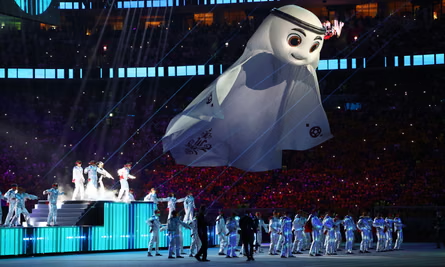
Long before the first tackle, a World Cup match can already feel unforgettable. National anthems, choreographed opening ceremonies, and those strange, collective goosebump moments do not add any xG, but they change how players carry themselves and how viewers read every duel, sprint, and press. They are the emotional preface to the tactical story that follows.
Why Pre‑Match Rituals Prime Our Reading of the Game
The sequence before kick‑off—teams emerging, flags, music, and camera close‑ups—acts like a lens that colours everything that comes after. When an anthem is sung with unusual volume or visible emotion, viewers instinctively expect intensity: harder presses, more committed challenges, and faster transitions once the match starts.
That expectation becomes a kind of confirmation bias. If the team begins aggressively, it feels like proof that the mood “carried onto the pitch”; if they start slowly, the contrast is striking and often triggers deeper tactical questions. Either way, the pre‑match ritual ensures that we watch the opening minutes not as neutral observers, but as people who have already seen a preview of the emotional level we think the game will reach.
How Anthem Moments Translate Into Early Tactical Intensity
For players, anthems and line‑ups are an extended pause before high‑speed decision‑making. The emotional surge can push a team into starting with a higher line, more aggressive pressing, or quicker attempts to play forward. For viewers trying to understand live matches, those first ten minutes become crucial diagnostic time.
If the team that looked fired‑up presses in coordinated waves—front three moving together, midfielders tight behind, back line stepping up—then the anthem emotion seems aligned with a clear game model. If the same emotion produces only scattered sprints and big gaps behind the press, it reveals a side more driven by feeling than structure. Noticing that difference early helps you predict whether their intensity will hold or break as the match settles.
Watching Live to Feel How Ceremonies Shape Perception During ดูบอลสด
During full‑match ดูบอลสด, you can see how opening ceremonies and anthem moments linger in the background of your perceptions. A host nation that delivered a spectacular ceremony and a roaring anthem often gets more patience from its crowd when early passes go astray or when the press is beaten. The emotional credit built before kick‑off buys them time.
For the viewer, this context can subtly influence tactical judgment. You might read a cautious first half as “controlling nerves” rather than as a lack of ideas, or interpret a sudden burst of attacks as the moment when the emotion finally finds a tactical outlet. Over multiple games, recognising this helps you separate what the stadium atmosphere suggests from what the structures and patterns on the pitch actually support.
A Simple Sequence for Linking Goosebump Moments to What Happens Next
To keep these irrationally powerful moments from completely dictating how you see a match, it helps to follow a deliberate internal sequence every time a World Cup game gives you goosebumps before kick‑off. The aim is to acknowledge the feeling while still grounding yourself in observable details.
A practical sequence could be:
- During the anthem or ceremony, notice which team seems more emotionally charged—body language, singing, eye contact—without yet deciding what that will mean tactically.
- In the first 10–15 minutes, focus on basic structural questions: where is the defensive line, how compact is midfield, and how well do forwards coordinate their press. Ask whether the “emotional” team also looks organised.
- Around the half‑hour mark, check whether intensity has been sustained or has clearly dropped—are presses slower, recoveries later, distances wider? Link any drop to possible fatigue from an over‑amped start.
- After half‑time, watch for contrast: does a team that looked flat in the anthem emerge sharper, perhaps after tactical adjustments, while the supposedly ready side fades?
- Near the end, ask whether late surges in effort—last‑ditch defending, extra attacking runs—come from renewed emotion, smart substitutions, or both.
Over time, this routine shows that goosebump moments are often the opening frame, not the whole picture. They may predict a fast start, but they cannot replace patterns in pressing, spacing, and chance quality as guides to how good a team really is.
Comparing Different Types of Pre‑Match Moments and Their On‑Pitch Echoes
Not all emotional moments are the same. Some are driven by national symbolism, others by the competition’s global spectacle, and each tends to leave different traces once the ball is rolling.
| Pre‑Match Moment Type | What You Feel as a Viewer | Common Early On‑Pitch Echoes |
| National anthem crescendo | Pride, unity, heightened expectation | Higher pressing intensity, aggressive duels |
| Opening ceremony spectacle | Sense of occasion, “big‑event” focus | Slight nerves, cautious opening, teams avoiding early errors |
| Minute of silence or tribute | Reflection, emotional weight, seriousness | Controlled tempo, fewer early risks |
| Host nation first appearance | Shared curiosity, patriotic pressure | Mixed: surges of attack punctuated by visible tension |
When you watch with these categories in mind, you can better judge whether what you are seeing is a sustainable tactical choice or a short‑lived reaction to the moment. A team that maintains compactness and smart rest‑defense even as the crowd roars is probably better constructed than one that spends the first quarter of an hour chasing everything and then fades.
How These Moments Can Help or Hinder Tactical Clarity
On the positive side, anthem and ceremony chills can make you pay closer attention. Knowing that you are watching a “big” moment often encourages you to follow entire sequences instead of only waiting for goals: you watch how the press builds, how a team’s first attempt to play out from the back looks, and how quickly they adjust after being pressed.
The downside is that emotional overload can make it harder to see simple tactical truths. A side carried by a deafening anthem might actually be second best in structure—open between the lines, slow to shift across, reliant on last‑ditch blocks—but the atmosphere can make them feel more dominant than they are. Being aware of this bias nudges you back toward asking calm questions about xG, positions, and recurring passing lanes once the initial rush settles.
Using Goosebump Phases to Anticipate Future Performances
The way a team behaves immediately after these emotional peaks offers hints for later in the tournament. A side that consistently channels anthem intensity into coherent pressing, controlled build‑up, and measured risk is likely to keep performing even when the stage feels less special, such as in a daytime group game without elaborate ceremonies.
By contrast, a team that needs huge pre‑match drama to reach its top level may struggle when circumstances are flatter—smaller crowds, early kick‑offs, or qualification already secured. Watching how they perform in both high‑ceremony and low‑ceremony settings helps you judge whether they rely on the occasion itself or on structures that travel well from match to match.
Summary
National anthems, opening ceremonies, and goosebump moments sit outside tactics, yet they quietly shape how we experience every World Cup game. They prime our expectations about intensity and commitment, influence how forgiving or critical we are in early phases, and colour the stories we tell long after the final whistle. When you enjoy the chills but still anchor your analysis in shapes, pressing, and chance quality, the tournament becomes richer: you feel the magic of the stage while seeing clearly what actually wins matches once the music stops and the ดูบอลสดวันนี้ changy begins.