
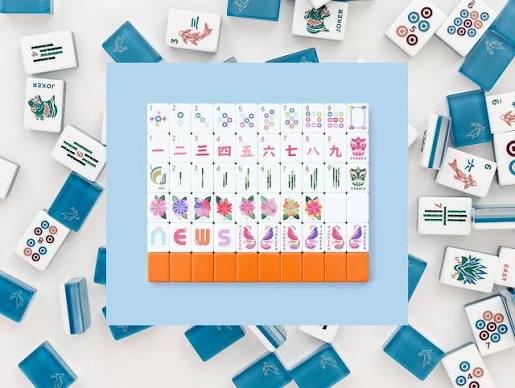
Mahjong tile art represents a distinctive blend of cultural heritage, craftsmanship, and visual communication. Its recognizable symbols, carefully arranged patterns, and contrasting colors have remained relevant across generations. Although the original designs were created for a traditional tabletop game, their visual characteristics have gradually influenced contemporary illustration, product design, and digital media. Understanding this evolution reveals how established artistic traditions can adapt to modern aesthetics without losing their defining features.
Historical Foundations of Mahjong Tile Art
The artistic development of Mahjong tiles is closely connected to the history of the game in China. Traditional sets feature several categories of symbols, including bamboo patterns, circular shapes, Chinese characters, and honor tiles. Each category follows a consistent visual structure, making individual pieces distinguishable while maintaining harmony across the complete set.
Early craftsmanship emphasized both durability and decorative quality. Artisans worked with materials such as bamboo, wood, bone, and other suitable substances, depending on the period and region. Engraving techniques allowed symbols to be incorporated directly into the surfaces, while contrasting colors improved visibility and enhanced their appearance.
These characteristics established a visual identity that could be recognized regardless of differences in materials or manufacturing methods. The relationship between function and decoration became one of the defining qualities of Mahjong tile design.
The Influence of Contemporary Design Principles
Modern visual design has introduced new ways to interpret traditional Mahjong imagery. Minimalism, geometric abstraction, and experimental typography offer alternatives to the detailed ornamentation associated with older tile sets. Some contemporary designers retain familiar symbols but simplify their shapes, creating cleaner compositions suited to modern visual environments.
Material innovation has also expanded the possibilities. Acrylic, resin, ceramic, and other manufactured materials can produce different surface effects, transparency levels, and color combinations. These developments allow designers to explore visual qualities that were difficult to achieve with traditional production techniques.
Digital illustration has further changed the creative process. Artists can adjust proportions, compare color palettes, and refine intricate patterns without repeatedly producing physical prototypes. This flexibility encourages experimentation while making it easier to preserve the recognizable elements of the original designs.
Color Theory and Symbolic Composition
Color plays an essential role in Mahjong tile aesthetics. Traditional sets commonly use red, green, blue, black, and white to distinguish symbols and establish visual contrast. These colors serve practical purposes, but their arrangement also contributes to the overall character of each set.
Modern interpretations may incorporate metallic tones, muted palettes, gradients, or luminous effects. Such choices influence how viewers perceive individual symbols and the relationships between them. Strong contrast can improve readability, whereas subtle color transitions can create a more refined appearance.
Composition is equally important. Designers must consider spacing, alignment, proportion, and the visual weight of individual elements. Excessive ornamentation can make symbols difficult to recognize, while overly simplified designs may remove details that contribute to their cultural identity. Effective composition balances decorative expression with clarity.
Mahjong Imagery in Digital Environments
The transition from physical objects to digital media has created additional opportunities for Mahjong-inspired artwork. Screen-based graphics require designers to consider resolution, display size, animation, and visual consistency. Details that appear clear on a physical tile may become difficult to distinguish when reduced to a small digital icon.
In Slot Mahjong, traditional tile motifs can be adapted into digital symbols, illustrated backgrounds, and animated visual elements. Examining these adaptations provides insight into how established cultural imagery is translated into interactive formats. Designers must preserve recognizable shapes while adjusting lighting, contrast, and proportions to accommodate different screen sizes.
These considerations also apply to mobile interfaces, digital illustrations, and other forms of visual communication. The challenge lies in maintaining the character of the original imagery while meeting the technical requirements of contemporary displays.
Preserving Cultural Identity Through Visual Innovation
The continued reinterpretation of Mahjong tile art demonstrates the relationship between historical craftsmanship and modern design practice. Traditional symbols provide a foundation for visual experimentation, while new materials and digital techniques introduce alternative ways to present familiar forms.
Cultural context remains important throughout this process. Understanding the origins and meanings of individual symbols helps designers make informed decisions about simplification, decoration, and visual adaptation. This awareness allows contemporary interpretations to explore new aesthetics without treating historical imagery as merely decorative material.
The result is an evolving design tradition in which recognizable motifs continue to inform artistic expression across physical products, illustration, and digital environments.